Showing posts with label Gharelu Nuskhe. Show all posts

Saturday, 25 July 2015

Control blood sugar levels with food

Control blood sugar levels with food

You can easily control your blood sugar levels with the foods you eat.
Control blood sugar levels with food
 
Regulating blood sugar levels is essential for good health, to maintain a healthy weight and to lower the risk of diseases such as type 2 diabetes and heart disease. According to new research published in the Public Library Of Science Medical Journal, people with high blood sugar levels are also at an increased risk of developing cancer.
Much of the food we eat is converted into blood sugar, which is used by the body for energy. Problems occur, however, when we have high or low blood sugar levels.
Here are the best ways to maintain healthy blood sugar levels.
  • Protein: One of the best ways to stabilise blood sugar levels is by including high-quality protein with each meal. The best sources include lean red meat, fish, chicken, eggs, legumes, nuts, seeds and tofu.
  • Chromium: Chromium helps normalise blood sugar levels and enhance insulin production. Sources include broccoli, wholegrain cereals, nuts, mushrooms and soy beans.
  • Reducing sugar: Reduce your consumption of sugary processed foods such as chocolates, cakes, biscuits, sugary breakfast cereal and soft drinks. These foods give a sharp rise in blood sugar levels.
  • Fibre: Fibre helps to stabilise blood sugar levels. It slows the absorption of glucose from food, which reduces the sharp rise in blood sugar levels. Best sources include wholegrain breads and cereals, brown rice, legumes, fruit and vegetables

Wednesday, 22 July 2015

Natural home remedies for Headach

Natural home remedies for Headach

Work stress, family demands, skimpy sleep schedules—everyday stresses can give us all a headache every now and then. Try these natural remedies to help ease your pain

Natural home remedies: Headaches
Oh, my aching head! In a world of traffic jams, tight schedules, and high-speed everything, it’s no wonder we find ourselves popping an occasional pain reliever. For a bad headache, choose one that contains a combination of aspirin, acetaminophen, and caffeine. (Off-limits...if you have a bleeding disorder, asthma, ulcers, or liver or kidney damage.) But painkillers are only part of the solution. There’s much more you can do to escape the thump and wallop of a throbbing noggin.

Give it some good press

With a firm, circular motion, massage the web of skin between the base of your thumb and your forefinger. Continue massaging for several minutes, then switch hands and repeat until the pain resolves. Acupressure experts call this fleshy area trigger point LIG4 and maintain that it is linked to areas of the brain where headaches originate.

Heat up and cool down

Believe it or not, soaking your feet in hot water will help your head feel better. By drawing blood to your feet, the hot-water footbath will ease pressure on the blood vessels in your head. For a really bad headache, add a bit of hot mustard powder to the water.

• For a tension headache, place a hot compress on your forehead or the back on your neck. The heat will help relax knotted-up muscles in this area.
• It might sound contradictory, but you can follow up the heat treatment (or substitute it) by applying a cold compress to your forehead. (Put a couple of ice cubes in a washcloth or use a bag of frozen vegetables.) Cold constricts blood vessels, and when they shrink, they stop pressing on sensitive nerves. Since headache pain sometimes originates in nerves in back of your neck, try moving the compress to the muscles at the base of your skull.
• Here’s an alternative to a cold compress: Soak your hands in ice water for as long as you can stand it. While your hands are submerged, repeatedly open and close your fists. This works on the same principle as an ice pack on your head—the cold narrows your dilated blood vessels.

Try the caffeine cure

• Have a cup of strong coffeeCaffeine reduces blood-vessel swelling, and thus can help relieve a headache. This is  why caffeine is an ingredient in some extra-strength painkillers like Excedrin. However, if you are already a heavy coffee drinker, skip this. Caffeine withdrawal can cause headaches, creating a vicious cycle.

Do something constrictive

• Tie a bandanna, scarf, or necktie around your forehead, then tighten it just to the point where you can feel pressure all around your head. By reducing the flow of blood to your scalp, this can help relieve the pain caused by swollen blood vessels. You might try soaking the bandanna in vinegar, a traditional headache remedy.

Soothe with scent

• Certain essential oils—especially lavender—can help ease tension and relieve the pain of a headache. Gently massage a bit of lavender oil onto your forehead and temples, then lie back and enjoy the relaxing scent. For maximum relief, slip away to a room that’s cool, dark, and quiet. The longer you can lie there quietly breathing in the aroma, the better.
• In addition to lavender oil—or instead of it—use peppermint oil. The menthol it contains can help dissolve away a headache. Its fragrance at first stimulates, then relaxes, the nerves that cause headache pain.
• If you have a vaporizer, add seven drops lavender oil and three drops peppermint oil, then breathe in the relief. If you don’t, try sprinkling a few drops of peppermint oil on a tissue. Inhale deeply several times.
• Try wringing out two wet peppermint tea bags and place them on your closed eyelids or forehead for five minutes.

Swallow some throb stoppers

• An anti-inflammatory, ginger was traditionally used to treat headaches, and it seems to work. Grind up a half-teaspoon ginger, stir it into a glass of water, and drink this “ginger juice.” Or pour 1 cup hot water over 1 teaspoon freshly ground ginger, let the tea cool a bit, then drink it. Ginger is especially effective against migraines, though how it works is not well understood. Doctors do know that ginger has an effect on prostaglandins, hormonelike substances that contribute to inflammation. Ginger also helps control the nausea that so often accompanies migraines.
• Try drinking a cup of rosemary tea; some people say it helps keep a headache from getting worse. Pour 1 cup boiling water over 1 teaspoon of the dried herb, steep for 10 minutes, strain, and drink.
• At least one grandmother counted on strong black tea with a few bruised whole cloves added. Tea contains caffeine, and cloves have anti-inflammatory properties, so the brew might indeed help a headache.
• Down a large glass of water and see if it helps. Dehydration can cause a headache.

The power of prevention

• If you grind your teeth or clench your jaw—either when you’re awake or asleep—take steps to prevent the problem. You might need to wear a mouth guard at night.
• Eat at regular intervals. There’s evidence that a drop in blood sugar—the result of going too long without eating—can set the stage for headaches.
• At least three days a week, spend 30 minutes walking, cycling, swimming, or doing some other form of aerobic exercise. These exercises are great stress-relievers.

Home Remedies for Hemorrhoids (Piles)

Home Remedies for Hemorrhoids (Piles)

Home Remedies for Hemorrhoids (Piles):

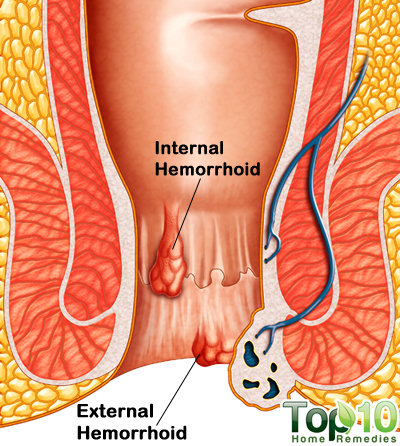
hemorrhoids medical diagram
Hemorrhoids, also known as piles, affect as many as 75 percent of people in the United States at some point in their lives. They most frequently strike when people are between ages 45 and 65.
This common problem occurs when veins in the anus and rectum become swollen and inflamed. A number of factors contribute to them, such as gravity, family history, constipation, a low-fiber diet, heavy lifting, obesity, food allergies, lack of physical activity, pregnancy, and prolonged sitting or standing.

Hemorrhoids are mainly of two types – internal or external. As the terms suggest, internal hemorrhoids develop inside the rectum and external hemorrhoids lie just below the skin around the anus.
Some common symptoms of hemorrhoids are blood clots or lumps around the anusbleeding during bowel movementsirritation near the anal region, and the urge to have a bowel movement even when there is no stool.
If left unchecked and untreated for too long, hemorrhoids may also lead to complications like chronic blood loss, strangulated piles, tissue death and even anal or colorectal cancer. Fortunately, it is not difficult to treat hemorrhoids and alleviate symptoms with simple, natural ingredients.
hemorrhoids home remedies
Here are the top 10 home remedies for hemorrhoids.

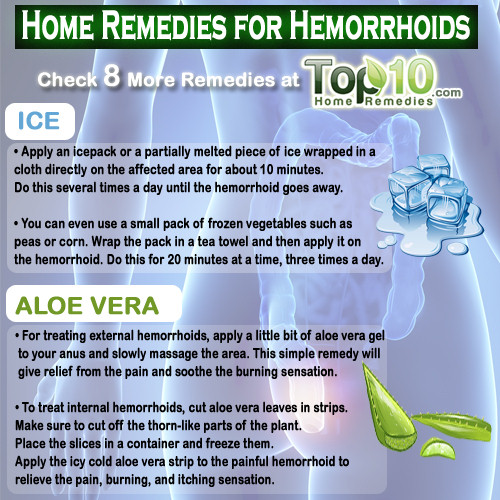
1. Ice

The first home treatment that is highly recommended is ice. Ice will help constrict the blood vessels, reduce swelling and give you immediate pain relief.
  • Apply an icepack or a partially melted piece of ice wrapped in a cloth directly on the affected area for about 10 minutes. Do this several times a day until the hemorrhoid goes away.
  • You can even use a small pack of frozen vegetables such as peas or corn. Wrap the pack in a tea towel and then apply it onthe hemorrhoid. Do this for 20 minutes at a time, three times a day.

2. Aloe Vera

Aloe vera is one of nature’s best ingredients for treating hemorrhoids. The anti-inflammatory and therapeutic properties of aloe vera help reduce the irritation of hemorrhoids. Aloe vera can be used for both internal and external hemorrhoids.
  • For treating external hemorrhoids, apply a little bit of aloe vera gel to your anus and slowly massage the area. This simple remedy will give relief from the pain and soothe the burning sensation.
  • To treat internal hemorrhoids, cut aloe vera leaves in strips. Make sure to cut off the thorn-like parts of the plant. Place the slices in a container and freeze them. Apply the icy cold aloe vera strip to the painful hemorrhoid to relieve the pain, burning, and itching sensation.

3. Lemon Juice

Lemon juice contains various nutrients that can give you relief from hemorrhoids by strengthening the capillaries and blood vessel walls.
  • Saturate a cotton ball with freshly squeezed lemon juice and apply it on the hemorrhoid. Initially there will be some mild tingling or a burning sensation, but relief from the pain will soon follow.
  • Alternatively, squeeze half a lemon into a cup of hot milk and drink it. Do this every three hours for best results.
  • Mix one-half teaspoon each of lemon juice, ginger juice, mint juice and honey together. Take this once a day.

4. Almond Oil

Almond oil, known for its emollient and deep tissue absorption properties, is used mainly for external hemorrhoid treatment. Dip a cotton ball in pure almond oil and apply it on the affected area. It moisturizes and eases inflammation, and will relieve the burning and itching sensation in and around the anus. Do this several times a day.

5. Olive Oil

Olive oil has anti-inflammatory and antioxidant properties and is used primarily to treat external hemorrhoids. It will help increase the elasticity of blood vessels, which in turn will help reduce inflammation and shrink the size of swollen blood vessels in the anal canal.
  • Consume one teaspoon of olive oil daily. It will help reduce inflammation and the monounsaturated fats will improve the functionality of the excretory system.
  • Crush the juice out of some plum leaves and add it to olive oil. Apply this mixture on your hemorrhoids. It will give you relief from the pain and swelling.

6. Whole Grains

Start eating whole grain products if you suffer from hemorrhoids. Whole grain products contain a good amount of fiber, which is highly effective in relieving hemorrhoid symptoms and bleeding.
This nutrient helps clean out the gastrointestinal system, preventing constipation and allowing the colon to work more efficiently. Fiber-rich foods can soften stool and increase its bulk, which helpsreduce straining during bowel movements. Some of the best whole grain products are oats, barley, maize, brown rice, millet, quinoa and buckwheat.

Health