Showing posts with label Body Health Tips. Show all posts

Wednesday, 22 July 2015

Natural home remedies for Headach

Natural home remedies for Headach

Work stress, family demands, skimpy sleep schedules—everyday stresses can give us all a headache every now and then. Try these natural remedies to help ease your pain

Natural home remedies: Headaches
Oh, my aching head! In a world of traffic jams, tight schedules, and high-speed everything, it’s no wonder we find ourselves popping an occasional pain reliever. For a bad headache, choose one that contains a combination of aspirin, acetaminophen, and caffeine. (Off-limits...if you have a bleeding disorder, asthma, ulcers, or liver or kidney damage.) But painkillers are only part of the solution. There’s much more you can do to escape the thump and wallop of a throbbing noggin.

Give it some good press

With a firm, circular motion, massage the web of skin between the base of your thumb and your forefinger. Continue massaging for several minutes, then switch hands and repeat until the pain resolves. Acupressure experts call this fleshy area trigger point LIG4 and maintain that it is linked to areas of the brain where headaches originate.

Heat up and cool down

Believe it or not, soaking your feet in hot water will help your head feel better. By drawing blood to your feet, the hot-water footbath will ease pressure on the blood vessels in your head. For a really bad headache, add a bit of hot mustard powder to the water.

• For a tension headache, place a hot compress on your forehead or the back on your neck. The heat will help relax knotted-up muscles in this area.
• It might sound contradictory, but you can follow up the heat treatment (or substitute it) by applying a cold compress to your forehead. (Put a couple of ice cubes in a washcloth or use a bag of frozen vegetables.) Cold constricts blood vessels, and when they shrink, they stop pressing on sensitive nerves. Since headache pain sometimes originates in nerves in back of your neck, try moving the compress to the muscles at the base of your skull.
• Here’s an alternative to a cold compress: Soak your hands in ice water for as long as you can stand it. While your hands are submerged, repeatedly open and close your fists. This works on the same principle as an ice pack on your head—the cold narrows your dilated blood vessels.

Try the caffeine cure

• Have a cup of strong coffeeCaffeine reduces blood-vessel swelling, and thus can help relieve a headache. This is  why caffeine is an ingredient in some extra-strength painkillers like Excedrin. However, if you are already a heavy coffee drinker, skip this. Caffeine withdrawal can cause headaches, creating a vicious cycle.

Do something constrictive

• Tie a bandanna, scarf, or necktie around your forehead, then tighten it just to the point where you can feel pressure all around your head. By reducing the flow of blood to your scalp, this can help relieve the pain caused by swollen blood vessels. You might try soaking the bandanna in vinegar, a traditional headache remedy.

Soothe with scent

• Certain essential oils—especially lavender—can help ease tension and relieve the pain of a headache. Gently massage a bit of lavender oil onto your forehead and temples, then lie back and enjoy the relaxing scent. For maximum relief, slip away to a room that’s cool, dark, and quiet. The longer you can lie there quietly breathing in the aroma, the better.
• In addition to lavender oil—or instead of it—use peppermint oil. The menthol it contains can help dissolve away a headache. Its fragrance at first stimulates, then relaxes, the nerves that cause headache pain.
• If you have a vaporizer, add seven drops lavender oil and three drops peppermint oil, then breathe in the relief. If you don’t, try sprinkling a few drops of peppermint oil on a tissue. Inhale deeply several times.
• Try wringing out two wet peppermint tea bags and place them on your closed eyelids or forehead for five minutes.

Swallow some throb stoppers

• An anti-inflammatory, ginger was traditionally used to treat headaches, and it seems to work. Grind up a half-teaspoon ginger, stir it into a glass of water, and drink this “ginger juice.” Or pour 1 cup hot water over 1 teaspoon freshly ground ginger, let the tea cool a bit, then drink it. Ginger is especially effective against migraines, though how it works is not well understood. Doctors do know that ginger has an effect on prostaglandins, hormonelike substances that contribute to inflammation. Ginger also helps control the nausea that so often accompanies migraines.
• Try drinking a cup of rosemary tea; some people say it helps keep a headache from getting worse. Pour 1 cup boiling water over 1 teaspoon of the dried herb, steep for 10 minutes, strain, and drink.
• At least one grandmother counted on strong black tea with a few bruised whole cloves added. Tea contains caffeine, and cloves have anti-inflammatory properties, so the brew might indeed help a headache.
• Down a large glass of water and see if it helps. Dehydration can cause a headache.

The power of prevention

• If you grind your teeth or clench your jaw—either when you’re awake or asleep—take steps to prevent the problem. You might need to wear a mouth guard at night.
• Eat at regular intervals. There’s evidence that a drop in blood sugar—the result of going too long without eating—can set the stage for headaches.
• At least three days a week, spend 30 minutes walking, cycling, swimming, or doing some other form of aerobic exercise. These exercises are great stress-relievers.
Home Remedies for Hemorrhoids (Piles)

Home Remedies for Hemorrhoids (Piles)

Home Remedies for Hemorrhoids (Piles):

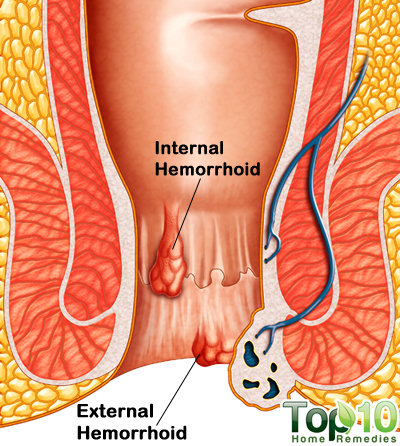
hemorrhoids medical diagram
Hemorrhoids, also known as piles, affect as many as 75 percent of people in the United States at some point in their lives. They most frequently strike when people are between ages 45 and 65.
This common problem occurs when veins in the anus and rectum become swollen and inflamed. A number of factors contribute to them, such as gravity, family history, constipation, a low-fiber diet, heavy lifting, obesity, food allergies, lack of physical activity, pregnancy, and prolonged sitting or standing.

Hemorrhoids are mainly of two types – internal or external. As the terms suggest, internal hemorrhoids develop inside the rectum and external hemorrhoids lie just below the skin around the anus.
Some common symptoms of hemorrhoids are blood clots or lumps around the anusbleeding during bowel movementsirritation near the anal region, and the urge to have a bowel movement even when there is no stool.
If left unchecked and untreated for too long, hemorrhoids may also lead to complications like chronic blood loss, strangulated piles, tissue death and even anal or colorectal cancer. Fortunately, it is not difficult to treat hemorrhoids and alleviate symptoms with simple, natural ingredients.
hemorrhoids home remedies
Here are the top 10 home remedies for hemorrhoids.

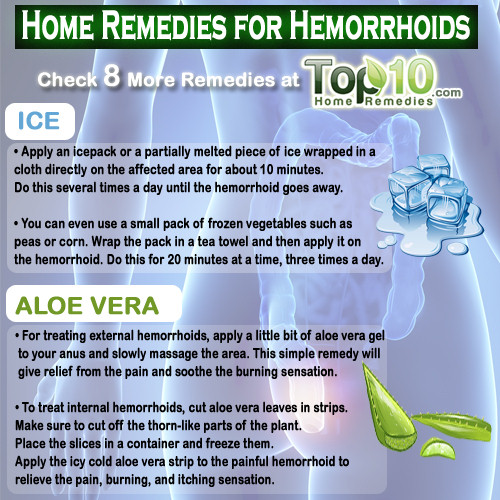
1. Ice

The first home treatment that is highly recommended is ice. Ice will help constrict the blood vessels, reduce swelling and give you immediate pain relief.
  • Apply an icepack or a partially melted piece of ice wrapped in a cloth directly on the affected area for about 10 minutes. Do this several times a day until the hemorrhoid goes away.
  • You can even use a small pack of frozen vegetables such as peas or corn. Wrap the pack in a tea towel and then apply it onthe hemorrhoid. Do this for 20 minutes at a time, three times a day.

2. Aloe Vera

Aloe vera is one of nature’s best ingredients for treating hemorrhoids. The anti-inflammatory and therapeutic properties of aloe vera help reduce the irritation of hemorrhoids. Aloe vera can be used for both internal and external hemorrhoids.
  • For treating external hemorrhoids, apply a little bit of aloe vera gel to your anus and slowly massage the area. This simple remedy will give relief from the pain and soothe the burning sensation.
  • To treat internal hemorrhoids, cut aloe vera leaves in strips. Make sure to cut off the thorn-like parts of the plant. Place the slices in a container and freeze them. Apply the icy cold aloe vera strip to the painful hemorrhoid to relieve the pain, burning, and itching sensation.

3. Lemon Juice

Lemon juice contains various nutrients that can give you relief from hemorrhoids by strengthening the capillaries and blood vessel walls.
  • Saturate a cotton ball with freshly squeezed lemon juice and apply it on the hemorrhoid. Initially there will be some mild tingling or a burning sensation, but relief from the pain will soon follow.
  • Alternatively, squeeze half a lemon into a cup of hot milk and drink it. Do this every three hours for best results.
  • Mix one-half teaspoon each of lemon juice, ginger juice, mint juice and honey together. Take this once a day.

4. Almond Oil

Almond oil, known for its emollient and deep tissue absorption properties, is used mainly for external hemorrhoid treatment. Dip a cotton ball in pure almond oil and apply it on the affected area. It moisturizes and eases inflammation, and will relieve the burning and itching sensation in and around the anus. Do this several times a day.

5. Olive Oil

Olive oil has anti-inflammatory and antioxidant properties and is used primarily to treat external hemorrhoids. It will help increase the elasticity of blood vessels, which in turn will help reduce inflammation and shrink the size of swollen blood vessels in the anal canal.
  • Consume one teaspoon of olive oil daily. It will help reduce inflammation and the monounsaturated fats will improve the functionality of the excretory system.
  • Crush the juice out of some plum leaves and add it to olive oil. Apply this mixture on your hemorrhoids. It will give you relief from the pain and swelling.

6. Whole Grains

Start eating whole grain products if you suffer from hemorrhoids. Whole grain products contain a good amount of fiber, which is highly effective in relieving hemorrhoid symptoms and bleeding.
This nutrient helps clean out the gastrointestinal system, preventing constipation and allowing the colon to work more efficiently. Fiber-rich foods can soften stool and increase its bulk, which helpsreduce straining during bowel movements. Some of the best whole grain products are oats, barley, maize, brown rice, millet, quinoa and buckwheat.

Tuesday, 21 July 2015

Bleeding Piles Treatment

Bleeding Piles Treatment

Bleeding Piles Treatment

This diagramic picture of piles shows internal piles, external piles and prolapsing piles.

This haemorrhoids picture clearly demonstrates the 3 major types of piles and all piles arise from veins, as can be seen in the background. Some treatments for bleeding piles depend on you knowing what sort you have.


For the most part, bleeding piles treatment is about finding the reason why your piles have become scratched and then prevent them from becoming scratched further, to allow your body the time to naturally heal the scratch and end the bleeding. Bleedng piles treatment therefore can be typically done at home, by just being gentler with them.

Causes of bleeding piles?

Although internal piles are swollen veins covered by mucus membrane, while external piles are swollen blood vessels covered by very thin skin, they are very similar in that both types of coverings are very easily damaged by any sort of trauma - twisting, excessive pressure, rough handling can damage the covering and tear the swollen vein. When the vein is scratched, bright red blood comes out of it, and you have bleeding piles.
Bleeding piles are mostly caused by the piles being scratched, such as from hard wiping or passing a hard stool. The blood loss from the scratch normally amounts to no more than a teaspoon of blood, but when mixed in the toilet water, it may look a heap more. Excessive blood loss from bleeding piles may occur that may lead to aenemia (lack of sufficient iron in the blood) or potentially become life threatening if the blood loss is quite severe. These latter types of bleeding is much much rarer.
Other causes of bleeding piles may be due to impact against a harder surface, such as a bicycle seat, which is effectively another way os saying the pile was rubbed too hard / subject to rough handling.

Do Bleeding Piles Require Treatment beyond being more gentler?

If you answer yes to one of these following questions:

Are you concerned you may have the piles bleeding through your clothing?

If you are, then chosing another line of bleeding piles treatment is obviously indicated, even if it is just using pads.

Is the piles bleeding an ongoing problem?

If this is the case, then other more intrusive treatment for bleeding piles needs to be considered. Chronic bleeding piles may lead to another type of pile called a thrombosed pile ( a pile with a blood clot in it ), and these are really painful and frequently require a surgeons hand - mine did. It is also obvious that if bleeeding is an ongoing problem with your piles, that the normal healing keeps being jeopardised.

Here are your options for treating bleeding piles - and there are quite a few options, to assist you in dealing with the causes of the bleeding:

The treatment of bleeding piles is normally quite easy, though it may take some time.

1. Toileting habits and constipation

Your first step treat bleeding piles should be to make sure your bowel motions / stools are soft

That basically means making sure you have enough fibre and water in your diet, and that you do some exercise ( about 30 mins a day walking for example ). The exercise helps keep the food moving through the digestive system, which means the it passes through you faster, which means the body has less time to pull water out of the stool and make it a harder stool as a result.
Also make sure that once the urge to for bowel motion occurs, that you answer nature, as the it is a weak urge that can easily pass, and again, the longer that motion stays inside you, the more water your body will remove from it.

Second step in your treatment for bleeding piles, is to make sure that you don't sit too long nor try pushing the bowel motion out.

If nothing has come out in five minutes, get up and move around. Sitting and straining puts a heck of pressure on piles, and if they are prone to bleeding, that pressure will certainly encourage them bleeding.

Third step clean the area well without harming the piles after each bowel motion

Soft moistened toilet paper should be used: Warm water on plain, unscented toilet paper or soft medicated wipes.
You can also use witch hazel or aloe vera wipes, as they soothe and reduce the piles inflamation, making bleeding less likely.

2. Another treatment for bleeding piles is sitz baths

Sit in a few inches of hottish water - NOT burning hot - for 15 to 20 minutes, about four times a day. You can add some epsom salts if symptoms of aching and pain are present, and or oatmeal for just general soothing.
The next step to this is to wrap ice into a towel and sit on it for 10 minutes.
It works by lowering the inflamation of the pile - helps the pile not to be so prone to bleeding.

3. Piles creams for external bleeding piles


Buy the NeoHealar piles cream that treats bleeding piles as well.

Buy Heal Bleeding Hemorrhoids - also known as H-Bleeding Hemorrhoids
If active ingredient is hydrocortisone, short term use only as it will weaken the tissue after a while.
If active ingredient is a vasoconstrictor - eg ephedrine, epinephrine, phenylephrine - they are good as a bleeding piles treatment. BUT, cant use them if you have diabetes, high blood pressure or cardiovascular issues. Also not advisable to use if urinary problem present or if you are taking anti-depressants.
Also good for bleeding piles are cream that contain lubricants, such as cocoa butter, as they help prevent the pile from becoming damaged or scratched.
Calamine lotion in a piles cream can also help stop the bleeding very fast.
Unless specifically designed for internal use, it is suggested that you avoid external creams and lotions for internal bleeding piles treatment - it is a an issue with possible overdosing on an active ingredient, because the internal ones, made of mucous membrane, absorb far more of the active ingredients than an external pile would - so the right does for external bleeding piles, is possibly going to be a massive overdose for internal ones.

4. Piles pills and tablets


Buy Venapro Piles treatmentRelieves constipation, reduces inflammation, counteracts pain, and its herbs are known for strengthening and repairing blood vessels.
Can treat bleeding piles. Ibuprofen reduces inflammation and pain, which helps reduce bleeding. Oral herbal remedies often treat bleeding piles.

5. Some simple lifestyle changes to consider

DIET: If you eat or drink anything that may cause your piles to flare, become more likely to bleed, then avoid them - common things often (not always) associated with this: Spicy food, hard nuts, caffeine products like coffee, and alcohol.
CLOTHING: Loose clothing made out of breathable material like cotton, help keep pile irritation to a minimum.
DON'T SCRATCH PILES: Even if they are itchy, no scratching, no scrubbing. Remember also, wounds often get itchy when they are healing, but scratching just opens the wound up again.
USE HYPOALLERGENIC: Laundry detergents, fabric softeners and soaps. Again reduces potential irritation that may lead to piles becoming itchy and scratched and bleeding.

Bleeding Piles Treatment in Conclusion

Bleeding piles is a very distressing, but common symptom of piles, but most bleeding piles can be healed at home, without having to resort to surgery and that is good news.

5 Simple Yet Powerful Ways to Take Care of Your Body

5 Simple Yet Powerful Ways to Take Care of Your Body

“Your body is precious. It is our vehicle for awakening. Treat it with care.” ~Buddha
Our bodies are not indestructible, and there is only so far we can push them before they start to fail. I should know.
Roughly three years have passed since my body became unwell, for whatever reasons. Despite suffering from extreme exhaustion and constant joint and muscle pains, like those you get when you have the flu, I’ve only just started to listen.


I guess the reason it’s taken me so long to do this is because I’m still holding onto the life I had before my usual activities began putting me in bed for days at a time. (I finished my degree at university and then went on to another part-time course for two years, while holding down two part-time jobs and running a student newspaper.)
After a year, I swapped being an editor for being a teacher and took up my teaching qualification. Amidst all of that, I moved onto a wreck of a boat, was without a bedroom for around four months, suffered a bereavement, and struggled to skim the edges of a mental breakdown as my depression reached critical mass.
My mental health has always been open to interpretation and discussion, but in my many years of happy insanity, my physical health has never suffered like it does now.
I’ve spent nearly a year improving my mental health by changing my attitudes, being more mindful, and practicing compassion and happiness. These things are ongoing, but I’ve given very little time to my body in the process.
When we’re stressed, we take time out to breathe and think happy thoughts, but what do we do for our bodies? Maybe we sometimes forget about that part. I know I do. So what can we do for our bodies alone when things are getting tough?

1. Take time for exercise.

I have to admit that I’m not a huge fan of this one because physical activity actually compounds the problems I experience with my body. But occasionally, when my joints aren’t screaming, I make sure that I keep my limbs limber by going for a gentle walk.
I’m slowly working my way towards practicing some basic yoga, too, but I’m having to take my time with that ambition.
This is the point of exercising your body–only do what your body can manage if you’re struggling, as there’s no point in making things harder. Even a little activity can have a huge impact.

2. Make sleep a priority.

If you’re tired, even if you feel that you need to get more done, give yourself permission to sleep. I ignored this simple notion for nearly a year when I first started feeling unwell. Now that I embrace it, my body thanks me for it. (You can read 9 tips to get better sleep here).
Admittedly, my condition keeps rest and sleep from being as refreshing as they might be for other people, but it still makes a difference. It stops me from doing further damage.

3. Eat well and savor it.

We’re encouraged to be increasingly mindful of what we eat nowadays, and for good reason considering the state of the food we consume. I’d like to encourage you, however, to turn your attention inward for a moment and think about eating as more than a bland necessity or ethical conundrum. Food is fuel, and we need it to function optimally
Eating well means feeding your body what it needs, in the most natural way you can manage and afford. Changing how you eat doesn’t need to be an all-or-nothing thing. Maybe you could add just an extra bit of fruit a day or swap a cup of coffee for a glass of water instead.
Relish the food you eat too, and take your time. Paying attention to flavors, textures, and smells, even the mechanical act of eating can soothe our bodies and reawaken us to the sensations of being alive. How long has it been since you’ve recognized your body like this?

4. Listen to pain.

When something hurts, something somewhere has gone wrong, and your body is trying to tell you that. We often pay no attention to pain unless it becomes unbearable: that tooth ache isn’t so bad, it can wait for a while; the sharp tugging in my shoulder is a result of repetitive strain but it usually goes by the time I’m home, so no need to worry.
These things, no matter how small, shouldn’t be brushed aside because they represent damage to our bodies. Ignore them and they could come back to haunt you later.

5. Slow down.

Because I’m still clinging on to the self that existed before I was feeling so rubbish, I tend to think I’m untouchable. I end up taking on way too much and then running around like a maniac. I can probably manage about two days of this sort of activity before I collapse and end up in bed.
If you’re likely to do the same as me, then I won’t be surprised if you scoff at the suggestion that you slow down. We all have so much to do and so little time to do it in and you want me to slow down? Who has time for that?
Rephrase the question: who doesn’t have time for that? The answer: our bodies.
If we squeeze every second out of our day at record speed, our flesh, bones, muscles, organs—the whole lot—will eventually suffer.
Since accepting my physical condition, I’ve become a slow life advocate. I have to live slowly for the sake of my body, and you know what? I quite like it!
I like that I only ever sit and write for two, maybe three hours tops, for a day. I like that I take whole days off to give my body time to recover.
Our bodies are precious, so why do we neglect them on such basic levels so often? A serene mind really is nothing without a healthy body to carry it. So take an hour—yes an hour!—out of your day a few times a week to care for it. Sleep, eat, rest, get a massage. Wind things down. Pay attention.

Health